
Beyond curry: the colourful, magical world of Indian spices
2026. 05. 26.
The magic of Indian cuisine begins with its aromas. The scent of sizzling cumin, the sweetness of browning onions, the freshness of cardamom or freshly crushed black pepper can already be felt before the first bite even reaches the plate. For centuries, Indian cooking has been built on a wide range of spices, which is why its flavours are so rich, deep and memorable. In Indian cooking, spices mean far more than simple seasoning. Behind a well-prepared curry, biryani or tandoori dish, a carefully planned balance lies: earthy aromas, citrusy notes, warm spice, fresh green flavours and gently measured heat all complement one another. This same approach defines the kitchen at the Taj Mahal, where every ingredient contributes its own character to the dish.
The art of Indian seasoning
When people think of Indian cuisine, curry is the first thing that comes to mind, although in reality India has thousands of different dishes and seasoning traditions. Because of the country’s vast size, the dominant ingredients vary across regions. In the north, richer, creamier sauces are common; in the south, coconut and hotter flavours play a greater role; in the west, more tangy and oil-based dishes appear; while in the east, mustard seed and lighter aromas often dominate.
One of the special features of Indian cooking is that the same spice can create different flavours depending on when and how it is used. Cumin, for example, gives a very different character when toasted whole than when ground into powder. Whole seeds release a nutty, deep aroma, while the ground version blends more softly into sauces.
Coriander also appears in several forms in Indian cuisine. Coriander seed gives bases a gently citrusy, warm aroma, coriander powder rounds out curries, and fresh coriander finishes a dish with a bright, green character. The same is true of pepper: whole black pepper is more intense and assertive, while ground white pepper blends more subtly into sauces.
Indian chefs know exactly when each spice shows its best side. Many recipes begin with oil or ghee, where mustard seeds, cumin, or ilaichi seeds crackle and release aromas. Onion, garlic and ginger then follow, forming one of the most important foundations of Indian curries.
Ginger’s fresh, mildly pungent character appears in almost every region. It gives food both depth and liveliness. Garlic makes sauces fuller and more distinctive, while the slow browning of onions builds natural sweetness into the base.
In Indian cuisine, spices rarely appear alone. They are like the instruments of an orchestra: interesting on their own, but together they create an entirely new world.
The world of warm and rich aromas
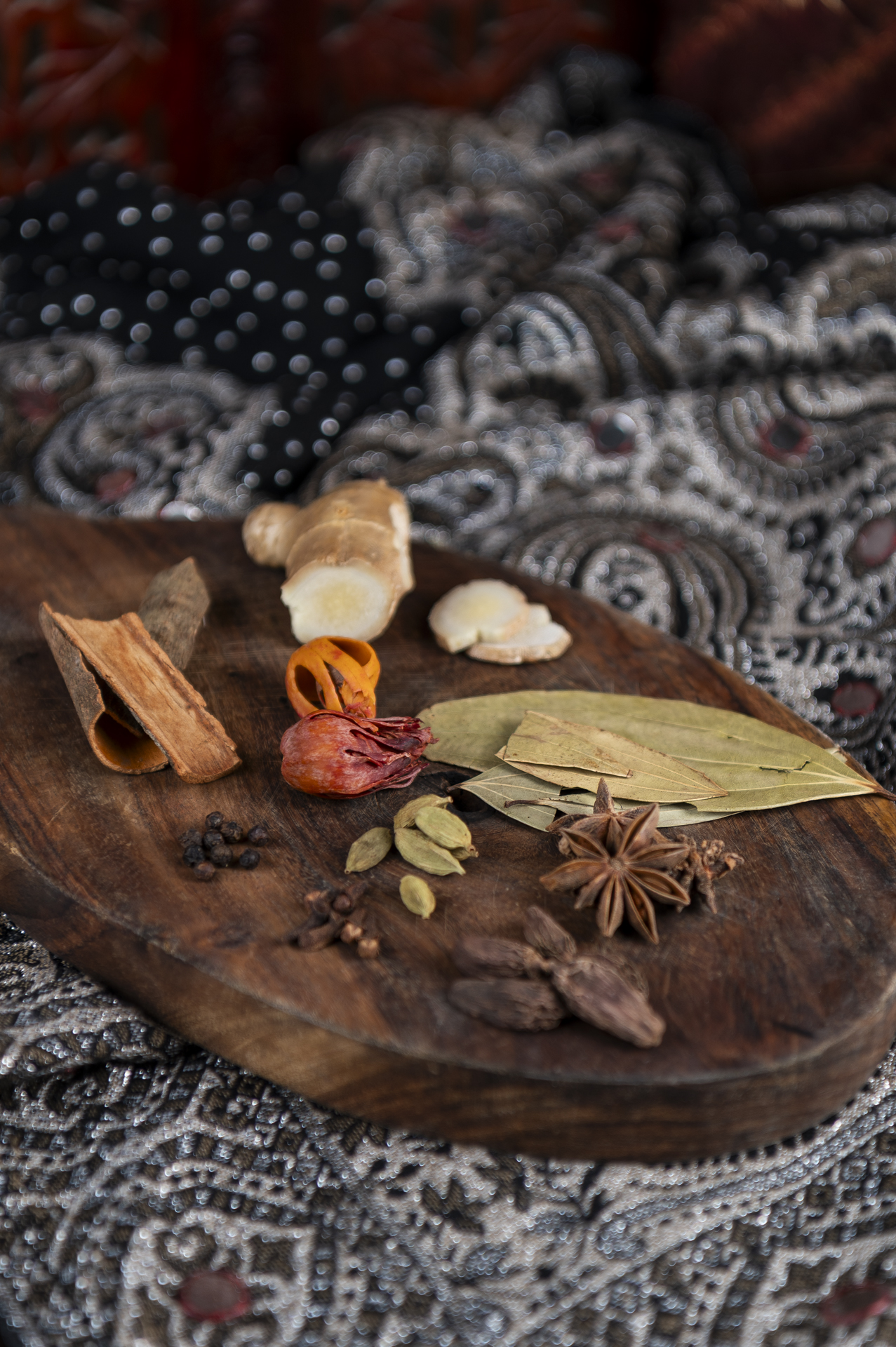
The depth of Indian dishes comes mainly from warm-character spices. These aromas are immediately recognizable when the lid of a biryani is lifted or when the first fragrance of a slow-cooked curry rises from the pot.
Cinnamon plays a very different role in Indian cuisine than it does in European desserts. Here, it often appears in savoury dishes, where its warm, slightly sweet character enriches sauces. In a good curry, cinnamon does not dominate; it gently connects the flavours.
Clove has a stronger and more concentrated aroma. Just a few pieces are enough to give a dish a deeper, more festive character. It plays a particularly important role in biryani rice dishes, rich meat dishes and slow-cooked sauces.
Cardamom is one of the most distinctive spices in Indian cooking. Green cardamom, known as ilaichi, has a fresh, slightly citrusy, almost eucalyptus-like aroma that is both elegant and intense. It appears in savoury dishes, rice dishes, desserts and traditional chai tea. Few spices can work in so many different ways.
Star anise also stands out visually among spices. Its sweet, anise-like character is most pronounced in richer, slower-cooked dishes. In Indian cuisine it is often added whole, so it can gradually release its aroma during cooking.
Black pepper holds special significance in India, as for centuries it was one of the country’s most valuable export goods. Indian black pepper is assertive, powerful and deeply aromatic. It is far more complex than the pepper most people are used to in an average European dish. White pepper represents a softer, more delicate direction, which is why it is often used in creamier sauces or lighter-coloured dishes.
Bay leaf is another important element of Indian seasoning. During long cooking, it gradually releases its aromas and works in the background, making the dish fuller. Many biryanis, dals and curries would be hard to imagine without it.
Together, these spices create the warm, rich fragrance that many people immediately associate with Indian restaurants.
A good example in our restaurant is bhuna, made with chicken or lamb. In this dish, the full range of the spices listed above is sautéed in oil, creating the foundation for its wonderful flavour. To preserve the aromatic scent released from the original spices, our Indian chefs prepare this dish fresh to order.
What does curry actually mean?
The word curry generally refers to Indian dishes served in sauce, although this broad term has spread from one particular style of preparation. In our restaurant, traditional curry sauce can be experienced, for example, in Chicken Curry Masala, Lamb Roganjosh and Mixed Vegetables Curry, all prepared at Taj Mahal according to the most traditional recipes. In these dishes, besides Indian spices, the most important ingredients are fresh onion, garlic, ginger, green chilli and tomato. At the end, the dish can be seasoned to taste with fresh herbs, coriander or parsley.
There is also a lesser-known spice called curry leaf, which is used specifically in South Indian vegetarian dishes. And of course, when speaking of the name, we should not forget curry powder, which is more of a seasoning blend popularised in England. In India, it refers more to spice blends that vary from region to region and family to family than to one specific spice. Moreover, Indians do not usually call saucy dishes “curry”; they tend to categorise their food by region, making a clear distinction, for example, between northern Punjabi cuisine and South Indian cooking.
The true strength of Indian saucy dishes lies in their foundations. These ingredients may seem simple at first, yet they form the basis of a dish’s character.
Turmeric, or haldi, is perhaps one of the best-known Indian spices. Its bright golden-yellow colour makes it instantly recognisable. Its flavour is earthy, slightly bitter and warm in character. Turmeric is not a loud spice, yet it is a fundamental ingredient in almost every Indian kitchen. Besides colour, it adds depth and fullness to curries.
Cumin is one of the most important aromas in Indian cooking. Whole cumin seeds are often toasted in hot oil at the beginning of a dish, when their nutty, slightly smoky character is immediately released. Ground cumin blends more softly into sauces and helps connect the different spices.
Coriander is one a pretty complex ingredient in Indian cuisine. Coriander seed has a gentle, citrusy, warm aroma that beautifully balances stronger spices. Coriander powder may appear in many dishes because it makes the flavours rounder and more harmonious. Fresh coriander is added to the top of a dish at the last moment, bringing freshness and lightness to rich foods.
Lets not forget of Fenugreek leaf, or as Indians calls it:Methi. In dried form, it is often added towards the end of cooking, where it gives sauces a distinctive, slightly intenzive depth. At the same time, if even slightly overused, it can make the flavour bitter. In many classic Indian dishes, this hard-to-describe aroma is one of the secrets. In our restaurant, the rich flavour of Methi Chicken and Methi Paneer is defined by fenugreek leaf.
Garlic and ginger together almost form the basic language of Indian cooking. The paste made from these two ingredients is the starting point of countless recipes. Garlic gives a stronger, fuller character, while ginger pulls the flavours in a brighter, fresher direction. In our restaurant, the marination of well-known Tandoori Chicken also includes ginger and garlic paste.
In Indian cuisine, fresh ginger is finely chopped or blended into a paste and added to hot oil directly after the onion. As it begins to fry, its intense, warm aroma gradually melts into the base of the dish. Ginger gives freshness, mild heat, and an unforgetful aroma, which is why many dishes would be almost unimaginable without it. In many Indian dishes, ginger creates the distinctive, rich flavour world that makes Indian cuisine instantly recognisable.
One distinctive feature of Indian curries is that spices are not added all at once. They are added gradually, and, in addition to quantity, the order is also very important, as different aromas are released at each stage. This is what makes curry truly layered and complex.
The real role of heat
Many people think Indian food is always very spicy, but Indian cuisine in reality is about balance. Heat is only one flavour among many, and a good chef knows how to use it without overwhelming other aromas. When many spices are used, numerous small flavours can strengthen the spicy impression together, even without added chilli or hot spices.
Red chilli gives dishes a stronger, deeper character. In dried and ground form, it often defines the colour of curries as well. There are milder, smokier varieties and more intense types that bring serious heat to a dish. A good Indian chef can choose from dozens of chilli powders.
Green chilli represents a fresher, livelier character. It is often finely chopped and added to sauces, chutneys and different snack-style dishes. It does not only add heat; its fresh, green aroma also enriches the flavour, making dishes feel fresher and more distinctive.
Black pepper is also part of the world of heat, yet it brings a completely different character. Chilli is felt more quickly and intensely, while pepper unfolds more slowly, creating a warmer, deeper sensation.
One of the great strengths of Indian cuisine is that it always treats heat together with other elements. Yoghurt softens stronger aromas, butter or cream makes curry complete and smooth, and coconut creates balance with its natural sweetness. This is why an Indian dish can be both intense and balanced. Alongside heat, there is always some softer, creamier or fresher element, so even stronger dishes can become easy to enjoy. An excellent example in our restaurant is the Goan Prawn Curry from Goa, one of the most distinctive sauce, gentle yet still deliciously spicy.
Fresh herbs and lighter aromas
Alongside the richness of Indian cuisine, there is always a fresh, bright side as well. Mint, fresh coriander, parsley, coconut, fresh ginger and countless varieties of fresh chillies all play an important role in this world.
Mint is especially popular in chutneys and yoghurt-based sauces, which are often served with grilled meats, tandoori dishes and various snack-style foods. Its cooling character beautifully balances spicier, more intense flavours. A fresh mint chutney can make a freshly grilled dish or crispy bites feel even brighter and more exciting.
Parsley appears less prominently, yet it plays an important role in certain dishes, especially when a lighter, greener character is needed.
Fresh coriander is one of the most important elements of Indian serving. Many dishes only gain their full character at the end, when a handful of chopped coriander is added on top. Its aroma is fresh, citrusy and lively, perfectly balancing the deep aromas created by long cooking.
Coconut is especially important in South Indian cuisine. It is used grated, as coconut milk or as oil. Coconut softens heat, makes sauces silkier and gives dishes a gentle sweetness. One of the best-known accompaniments in South Indian food is coconut chutney, made from fresh coconut, spices and green chilli. This cooling, creamy dip is often served with dosa, idli and other traditional South Indian dishes, where its freshness and soft texture create a balance of flavours. We are proud to have been the first in Budapest to offer traditional South Indian dishes, which have since become favourites for many guests.
The hidden characters of Indian cuisine
There are spices that are less familiar in Europe, yet play a defining role in Indian cooking. These are often what give a dish that special character which is hard to identify precisely, but makes the food memorable.
Mustard seed truly comes alive in hot oil. When it begins to pop, it releases slightly nutty, piquant aromas. It is especially common in South India, often forming the base of lentil dishes and vegetable sauces.
Onion seed, or kalonji, is one of the most interesting Indian spices. Its tiny black seeds carry a slightly oniony, peppery and nutty character. It is often used on top of naan breads, in pickles or in oil-based spice mixtures.
Black salt can be surprising at first encounter. Its sulphurous, mineral aroma is very distinctive, so it is used in small quantities. It plays an especially important role in chaat-style dishes and various snack foods, giving them a unique character with its specific flavour. In India, many people also season fresh fruits, such as watermelon and other sweet fruits, with black salt because the salty, mineral aroma intensifies the fruit's sweetness.
Garam masala is perhaps the best-known spice blend in Indian cuisine, yet there is no single universal recipe for it. Its composition varies by family, region and restaurant. It usually contains spices such as cardamom, cinnamon, clove, pepper or cumin. It is often added to the base of a dish during cooking, while many chefs sprinkle a little more garam masala over the dish near the end so its fresh, intense aroma comes through even more strongly.
In Taj Mahal Restaurant, we also use our own homemade garam masala, freshly ground to lend our dishes their distinctive aroma.
The achari oil spice mixture, which we also prepare in-house, represents an entirely different world. “Achar” originally means Indian pickle, stored in heavily spiced, intensely flavoured oil and eaten alongside meals. This piquant, spicy, slightly tangy oil gains its distinctive aroma from spices such as mustard seed and nigella seed. In achari-style dishes, this spiced oil is also often used during preparation, adding special depth and bold flavour.
These lesser-known ingredients are what make Indian cuisine truly exciting. They bring flavours that may seem unusual at first, but soon become memorable.
How is a true Indian saucy dish built?
Preparing a good Indian dish is more about layering than simple cooking. Aromas are built one after another, and every step adds a new flavour to the food.
The first stage often begins with hot oil or ghee. This is where the whole spices are added: cumin, mustard seed, bay leaf, cinnamon, cardamom. As the oil absorbs their aromas, their fragrance fills the entire kitchen. The order matters, as does how long each spice is left in the oil before the fresh, finely chopped onion is added,slowly browned until it becomes golden and slightly sweet. The next layer is fresh ginger and garlic, which add freshness and depth to the base.
Powdered spices are added only after this. Turmeric, coriander powder, cumin powder, chilli, and many kinds of spice blends are briefly toasted at this stage to release their aromas.
Tomato, yoghurt or coconut milk then creates balance within the intense spicing. During longer cooking, the flavours come together, smooth out and deepen.
At the end, a little garam masala and fresh coriander are often added. This gives the dish its final aromatic layer, making it fresher and more complete.
In a truly good curry, no single flavour dominates. Instead, it offers a constantly changing, layered experience, where a different flavour comes forward in every bite.
The spicy world of Taj Mahal’s kitchen
In authentic Indian cuisine, respect for spices is one of the most important principles. In a good Indian restaurant, spices are not merely in the background; they form the soul of the dishes.
In the Taj Mahal kitchen, the traditional approach to Indian cooking meets carefully selected, high-quality ingredients. Freshly ground spices provide more intense aromas; toasting whole spices in oil creates deeper character; and homemade spice blends create a unique flavour world across more than 100 dishes on our restaurant’s menu, selected from different regions of India.
The beauty of Indian cuisine lies precisely in the fact that the same basic spices can be used to create endlessly varied dishes. Cumin, coriander, turmeric and cardamom all show a different face in every dish.
After a well-prepared Indian meal, we often do not remember one single spice, but the whole experience. The aromas, the slowly unfolding flavours and the special harmony make Indian cuisine one of the most exciting culinary worlds.
The world of spices is exciting even on paper, but the true experience comes when these aromas meet in a freshly prepared dish. Book a table at Taj Mahal Restaurant and discover the rich, layered flavour world of Indian cuisine in person.