
“Add a little haldi” – where two culinary traditions meet in a Hungarian–Indian home
2026. 09. 09.
What kind of Indian food appears on the family table of someone who has run an Indian restaurant for decades? In Singh Zsóka’s home kitchen, dishes learned from her mother-in-law sit alongside Hungarian favourites and her own recipes inspired by two culinary traditions. The kitchen at Taj Mahal works with different equipment, quantities and techniques from those used in a family home. In this interview, the restaurant owner explains how she cooks Indian food at home, what she learned from her husband’s family and which approaches to seasoning are most useful for beginners.
What does family cooking look like in a home where chicken paprikas, aloo paratha and an original turmeric-and-rosemary chicken dish all belong at the same table? We spoke to Zsóka Singh, who has run Taj Mahal Indian Restaurant with her husband for over two decades, about the first flavors that made a lasting impression on her, the knowledge she inherited from her mother-in-law and the realities of cooking Indian food at home. We also learned why a restaurant dish cannot simply be recreated in a domestic kitchen and where someone experimenting with Indian flavors for the first time should begin.
Do you remember your first encounter with Indian cuisine? Was there a particular flavor that immediately appealed to you?
It actually goes all the way back to my childhood. Not long after the fall of communism, I traveled to the United States with a school choir. We stayed with local families, and for those of us who had grown up in socialist Hungary, seeing such a completely different world was an incredible experience.
They took us to a food court where all kinds of food were on offer: Mongolian, Mexican and Indian. We had no idea what any of it was. I thought I was very adventurous, so I deliberately went for the spicy dishes.
The richness of the seasoning was astonishing because I had never experienced anything like that before. We had grown up in a world of processed cheese cubes and Camping cheese, after all.
Then, for years, I almost forgot about the experience. For a long time, I wondered whether the flavor I remembered had ever really existed.
As an adult, Butter Chicken was my first truly memorable encounter with Indian cuisine. We were eating abroad, and I must have been around eighteen. I had not even ordered it myself; Lucky, my husband, had.
Until then, I had never chosen a dish with a tomato-based sauce. I thought I disliked it because I always imagined something strongly tomato-flavored and Italian in character.
I was amazed that a tomato-based dish could taste so completely different. The spices gave it a rich, complex, and highly distinctive flavor. Suddenly, that childhood memory returned, and I realized that yes, the taste I remembered really did exist.
Did meeting Lucky renew your interest in Indian cuisine?
Of course, although I did not fall in love with him because of the food.
Lucky’s parents moved to Hungary when they were older, and we lived together for many years, until they passed away. My first truly close experience of Indian cuisine therefore came through my mother-in-law’s home cooking rather than restaurant food. It was a completely different world.
I was fortunate enough to watch her cook every day. As she grew older, she increasingly directed me from the side: she told me what to add, how much to use, and when it was time for the next step.
Her way of thinking about food was simple and instinctive. When she considered an ingredient “warming” for the stomach, she looked for something “cooling” to balance it. She added haldi, or turmeric, to almost everything because she believed it helped cleanse the body over time.
She added jeera, or cumin, to chickpeas and other ingredients that are harder to digest because she believed it supported digestion. She never considered flavor alone; she also thought about how the ingredients could balance one another. That mindset was so typical of a traditional Indian home cook.
So it was primarily your mother-in-law who taught you to cook Indian food, rather than the restaurant chefs?
Yes. Almost everything I know about Indian home cooking came from her.
People might assume that because we have owned a restaurant for over twenty years, I must have learned everything from the chefs. Restaurant cooking, however, is an entirely different profession. I could not simply step into the kitchen if one of our chefs called in sick. You cannot learn that job merely by watching other people work.
The equipment, quantities, and entire process are different. Take cashews, for example. To make the sauce for Chicken Corma truly smooth, they must be blended into a completely silky paste without a single piece remaining. You cannot achieve exactly the same result at home.
People often ask us to share the recipes for particular restaurant dishes. It is not that we are unwilling to tell them. The problem is that the result will not necessarily be the same under domestic conditions.
My own learning began when a baby was born to my husband’s sibling and his parents traveled to India for an extended period. Before they left, I asked my mother-in-law to dictate a few basic recipes so that we could continue cooking Indian food while they were away.
I still have those pieces of paper. I did not write down complicated recipes, only the essentials: how to prepare different lentil dishes, how to make paratha, and which simple vegetarian meals could be cooked at home.
Incidentally, my mother-in-law never cooked meat at home. It was not a matter of principle; she simply had no instinct for preparing it. If I cooked meat, or if we went to a restaurant, she was perfectly happy to eat it. At home, she mainly made lentils, vegetarian dishes, flatbreads and sweets.
What was your first real success in the kitchen?
Honestly? Initial attempts are usually quite weak—that was the case for me too. Practice makes a great difference.
When Lucky’s parents returned from India, I enthusiastically prepared a tomato-based dish with Indian cheese for them. I even made the paneer myself. My mother-in-law had taught me how.
I have hardly ever made paneer at home since then because I am in a privileged position: whenever I need some, I can simply ask the restaurant for a fresh batch, as they make it every day. At the time, however, I was extremely proud of myself.
My mother-in-law tasted the dish and gently remarked that I had cooked it a little too long.
That was when I learned that a tomato-based sauce cannot be cooked indefinitely. If it stays on the heat for too long, its flavor can become extremely intense and almost bitter. There were dishes I had to prepare three or four times before I finally got them right.
By now, I can cook many things confidently. Over time, we have also developed our own recipes, combining elements of European, Hungarian and Indian cooking.
Would you describe the food you cook at home as Hungarian–Indian fusion cuisine?
Not entirely. We essentially have three types of food at home: I cook traditional Hungarian or European dishes, completely traditional Indian food and a few recipes of my own in which the two culinary traditions meet in some way.
One of these is a very simple turmeric-and-rosemary chicken. I used to pan-fry chicken breast with a little olive oil, butter and rosemary in a slightly Italian style.
Once, while I was cooking for my young child, my mother-in-law said, “Put some haldi in it. It’s very good for the stomach.”
I tried it, and over time it developed into a recipe that I still make very often. I add turmeric, a tiny amount of thyme and oregano to the oil, along with a more generous quantity of rosemary. I place the salted chicken slices on top and cook them until tender, which takes around ten minutes. At the end, I sprinkle a little ground rosemary over them.
We eat it with rice, and the children hardly want it anymore without turmeric. Without it, the chicken is not yellow, and the flavor is completely different. Every Hungarian relative and friend who has tried it at our house has enjoyed it.
I have other recipes of my own as well. I am gradually revealing all of them, so there will soon be very little material left for my fusion cookbook.
For example, I sometimes mix a vegetable curry with cooked pasta, put it in a baking dish, grate cheese over it, and bake everything together. Recently, I have also started adding Parmesan. Indian and Hungarian guests alike are surprised that the two cuisines can be brought together in this way.
We also make pizza with Indian toppings. At the restaurant, we have a spicy minced-meat curry called keema. We spread it over the pizza dough and add cheese. It is a little like Turkish lahmacun, only with Indian seasoning. My eldest son absolutely loves it and constantly asks when we are going to make it again.
Which Indian foods are part of everyday life in an average family?
Chapati and the various types of paratha certainly belong in that category.
Indian home cooks who prepare Indian food every day generally make the chapati dough in advance. It is a basic dough made from flour, water and a little oil, which is kept in the refrigerator. A fresh batch is kneaded every two or three days.
Before a meal, they tear off a piece, shape it into a ball and roll it into a thin, round disc, rather like a crêpe. It is then cooked on both sides on a hot, dry surface without any added fat. They always make only as many fresh chapatis as the family needs. They are served as an accompaniment to lentils and vegetable dishes.
Paratha is made from the same dough, only with a filling. Spiced potato, for example, is placed inside the rolled dough, which is folded into a parcel and rolled out again. This creates layers of filling within the dough.
The best-known version is aloo paratha, or potato paratha. My mother-in-law often made it for breakfast, and we cooked it together countless times. I can also make versions filled with onion, lentils, and various other ingredients.
It is not exactly diet food, although it is delicious. It is not deep-fried like Hungarian lángos. First, both sides are cooked on a hot, dry surface, and only then is it crisped with a small amount of oil.
Do you have any special equipment in your kitchen for preparing Indian food?
One item is a mortar and pestle, which is used to crush whole spices.
I once visited my sister-in-law abroad and took all kinds of spices with me because I knew they would be pleased if I cooked an Indian chicken dish with rice. When she saw the whole spices, she brought out a mortar and pestle that she hardly used before. She was delighted to finally have it in use.
Cardamom, for example, needs to be lightly crushed. The small seeds sit inside a thin pod, and once the pod opens, their flavor is released much more effectively.
Another typical piece of equipment is the tawa. It resembles a frying pan, except that it has almost no sides and is practically flat. It is somewhat similar to a Hungarian crêpe pan. Chapati and paratha are cooked on it.
A traditional tawa is made from black metal. My mother-in-law would often simply wipe the flour from it with a piece of paper. Naturally, I always washed it because in that respect I am far too European.
Is rice also prepared differently in Indian and Hungarian cooking?
Yes. Basmati rice has a remarkably distinctive fragrance. Its appeal is not simply that it is long-grained.
When it is cooked properly and then allowed to rest under a lid for a short while, it develops a delicate and characteristic aroma. It smells different from ordinary rice. Once you become accustomed to it, you are reluctant to replace it with another variety.
My mother-in-law often prepared rice very differently from the way we usually do in Hungary. She would add spices and onion to a small amount of oil. She often toasted whole cumin seeds in it before pouring in the measured quantity of water. Then she added the washed rice and salt and cooked it covered.
There are countless varieties of spiced rice. I am particularly fond of the cumin version.
Biryani is a world of its own. It is a rice dish in which different ingredients are cooked together under a lid. Traditionally, even the lid is sealed with dough so that all the steam and aromas remain trapped inside. The pot is opened when the dough begins to crack from the heat.
There is a traditional, tightly closing vessel called a handi that is used for this, although at home it can also be prepared in an ordinary pot with a well-fitting lid.
Is it difficult to find Indian ingredients in Hungary today?
These days, almost everything is available. Indian and international spice shops stock specialized ingredients and equipment alongside the basic spices. These shops are supported largely by the needs of the communities living here, including the Indian community.
In the unlikely event that something is unavailable in Hungary, you can almost certainly find it in Vienna. The selection is even broader in Germany or England. Sometimes you can buy in a single shop what would only be available regionally in different parts of India.
Which spices should a beginner buy before attempting to cook Indian food?
That depends partly on how much they enjoy spicy food.
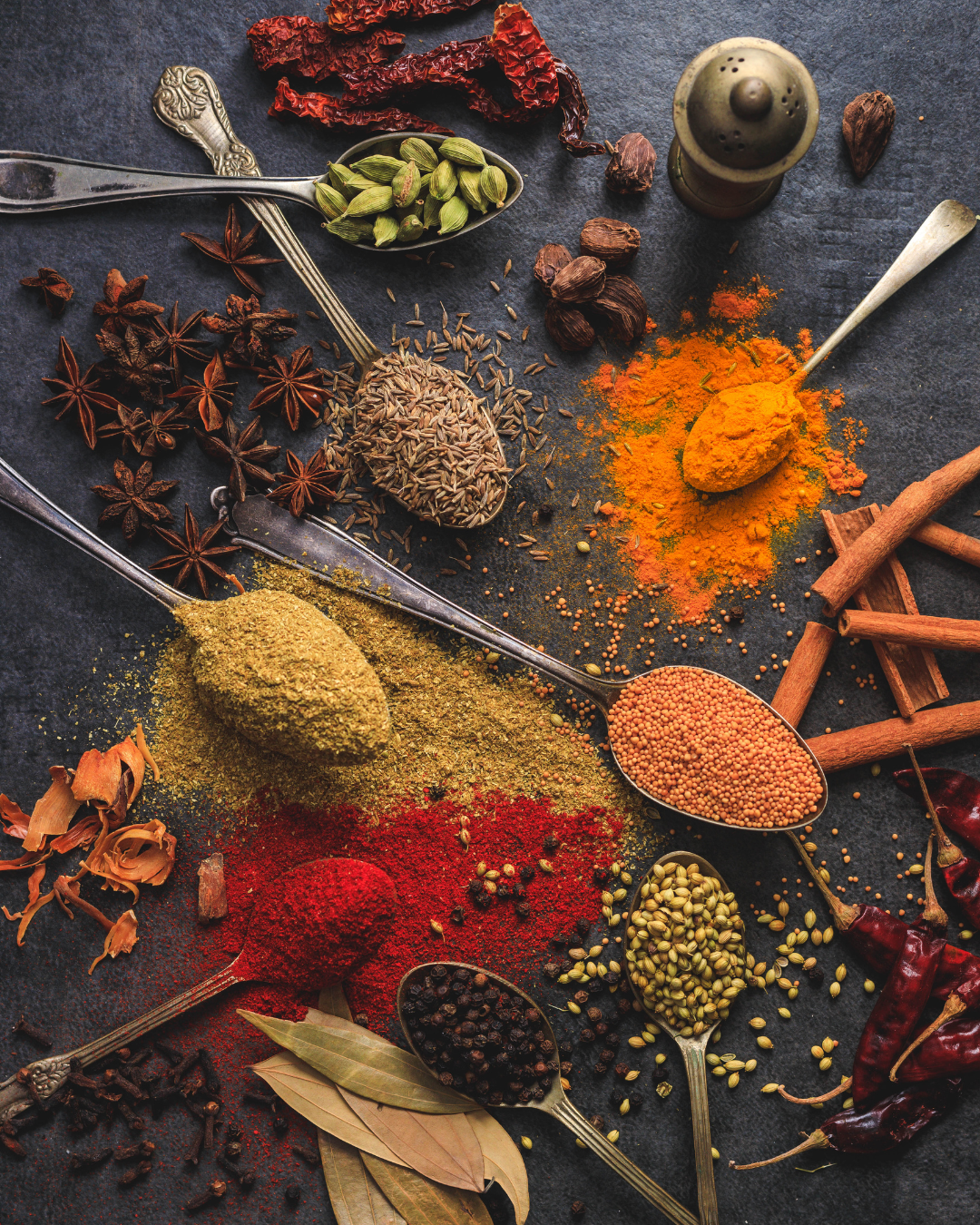
Red chili, garam masala, whole and ground cumin, known as jeera, and turmeric are among the essentials. Cumin cannot really be replaced with Hungarian caraway. Although both are commonly referred to as types of “kömény” in Hungarian, they taste completely different.
Ginger and garlic are virtually indispensable. Cardamom is also important. Both green and black varieties are available, and they are used differently. Cinnamon, black pepper and cloves are frequently added to dishes, while white pepper is used in paler sauces.
Fresh coriander is also extremely important. Methi, or fenugreek leaves, can be purchased fresh or frozen. In that form, it is used less as a spice and more as a leafy vegetable, somewhat like spinach.
Dried fenugreek leaves are used as a spice. They look slightly like oregano, although their aroma is incredibly intense. They need to be stored in a tightly sealed container; otherwise, the entire kitchen will soon smell of them.
Can Indian cooking be learned from cookbooks?
I have often had disappointing experiences with cookbooks, particularly Hungarian-language ones.
I have found very few recipes that produced something I could honestly describe as tasting the way an Indian dish should. That does not mean the recipes are impossible to cook or necessarily bad. It is simply that if I had to rate their authenticity on a scale of one to ten, I would often give them no more than a three.
The main problem is that someone who does not know the original flavors cannot judge whether the food on their plate has turned out properly.
There are more authentic recipes online, often written by people who genuinely cook the dish in question. Even there, however, finding a good recipe can be rather hit-and-miss.
I own one or two cookbooks with individual recipes that have not disappointed me. I have yet to find one whose entire collection of basic recipes I would consider reliable.
Hungarian people are perfectly capable of cooking these dishes. It is wonderful to broaden the range of foods and spices you use instead of relying on the same flavors every day.
Have you ever considered writing your own Indian home-cooking book?
Perhaps, provided I could make it authentic enough.
My mother-in-law could tell exactly how a dish should be simply by looking at and tasting it. She was the best at that. As a young man, Lucky did not pay attention to what his mother was cooking or how she prepared it. I was there beside her because we lived together.
Someone who cooks every day develops an entirely different instinct for food. That is why a book like this would need to do more than list recipes. It would have to be genuinely useful to someone attempting the dishes at home.
I learned to make Indian tea, or chai, from my father-in-law. He was an extremely precise man. He did not really cook anything else, although he prepared tea in exactly the same way every morning. I still make it that way today.
My eldest son also loves it. When we have to get up early and he is very tired, I sometimes make him a strong black tea to help him wake up and get to school. I have a feeling he will carry that tradition forward.
Does Indian cuisine have fundamental techniques comparable to making a roux in Hungarian cooking?
It does, although when you first see ten packets of Indian spices in front of you, it is very difficult to decide how much of each one to use.
With Hungarian seasonings, we instinctively know which ingredients require only a pinch, which need a small spoonful or a teaspoon, and which can be used more generously. With Indian spices, that sense of proportion has to be learned separately.
You also need to know which spices go into the oil at the very beginning and which are added later for seasoning. Almost all of them have powerful flavors, so the quantities matter. There are spice blends that even I still find challenging. I begin with a small amount and adjust the flavor by tasting.
One of the most important basic techniques is to add the spices to the oil first. The onion follows, then the ginger and garlic. These ingredients must be sautéed properly, and those five to ten minutes cannot be skipped or rushed.
After that, you can add chicken, a little tomato, and salt, for example. That alone can produce an excellent, simple chicken dish.
Fresh herbs, on the other hand, are usually added towards the end of cooking. This differs from the way parsley or celery leaves are used in some Hungarian dishes, where they may cook with the food throughout the entire process.
Lentil and legume dishes also have a characteristic method. Indian home cooks usually cook chickpeas, beans or lentils in a pressure cooker. They prepare the spices separately, pour them into the cooked lentils and then continue cooking everything together.
Timing is the most difficult part. You need to know how long to cook the lentils initially so that, after the seasoning has been added and they have cooked further, their texture will be exactly right.
Is there a type of Indian dish that you still find challenging?
Lentils. I cook them, but they never turn out exactly like those made by my mother-in-law or the restaurant chefs.
My mother-in-law could use a pressure cooker without constantly opening it and tasting the contents. From the cooking time and the type of ingredient, she knew precisely how long it needed. I still do not have that level of certainty.
I am forever opening the pot and tasting. The lentils also continue cooking after the seasoning is added, so it is very difficult to identify the moment when they are soft enough without allowing them to fall apart completely by the end.
I consider myself quite good at vegetable and chicken dishes now. Since my mother-in-law passed away, Lucky sometimes tastes something and says, “Oh, you made this exactly the way Mum used to.” That is the greatest compliment.
He does not praise my lentils very often, though, which occasionally makes me lose my motivation to cook them.
Have any Hungarian dishes become family favorites as well?
Many of them.
Lucky loves chicken paprikas and breaded fried cheese, for example. He eats almost everything I cook.
Indians are generally less enthusiastic about soup, or at least Lucky is not much of a soup eater. When his sibling visited Hungary, however, they became very fond of Hungarian soups. It was a real discovery because Indian cuisine does not have dishes quite like Hungarian meat broth, goulash soup, or creamy ragout soup.
When my mother-in-law was older, I managed to introduce her to Hungarian soups, and she enjoyed them very much. Lucky usually eats them only because I keep explaining how healthy they are.
In my experience, middle-aged and younger Indian people are generally not particularly keen on soup.
What do you think of Indian fast food and street food?
It is far richer and more exciting than what Europeans generally call fast food. A great deal of it is also prepared fresh, which gives the food a completely different quality.
In India, it is almost impossible to walk down a street without encountering all kinds of food vendors. One may sell boiled corn, while another offers peeled carrots or other vegetables. There are countless types of chaat, in which different ingredients are assembled into a complete dish.
There is a huge variety of vegetarian food, although you also find tandoori vendors who cook chicken on the spot and serve it with bread. Chai sellers with their large pots are everywhere, and naturally there are also countless sweet shops.
To be honest, as a tourist, I did not try street food very often. You cannot rule out the possibility that it has been prepared with tap water or with fresh ingredients that our European digestive systems may not tolerate well.
Lucky, on the other hand, always eagerly dives into Indian street food whenever he is in London because that particular risk is not the same there.
Where should someone begin if they are trying Indian cooking for the first time?
The first step is to understand the ingredients instead of randomly adapting the recipe to Hungarian tastes.
The order in which the spices are added is crucial. The basic spices go into the oil first, followed by the onion, ginger and garlic, which need to be sautéed. Those five to ten minutes cannot be skipped or rushed.
Once you understand this process, it is difficult to go seriously wrong. Add chicken, a little tomato and salt to that base, and you can create an excellent chicken dish you will be proud to serve.
Zsóka’s turmeric-and-rosemary chicken
A simplified recipe designed to give beginners a sense of achievement.
Ingredients:
Chicken breast fillets cut into slices, olive oil, a little butter, turmeric, a small amount of thyme, a small amount of oregano, plenty of rosemary and salt.
Method:
Add the turmeric, a very small amount of thyme and the rosemary to the olive oil and butter. Use the thyme and oregano sparingly, as too much can make the dish taste bitter.
Place the chicken slices in the seasoned oil. Cook until tender, which should take around ten minutes, and season with salt.
At the end, sprinkle over a little more ground rosemary and serve with rice. Once you have learned how spices behave in hot oil, you will be ready to try your next Indian dish.